Java 17: LTS Released After 3 Years
Last September, a new Java LTS (Long-Term-Support) version was released after three years. I summarized notable release notes for Java 14 last year, and now we are already at Java 17.
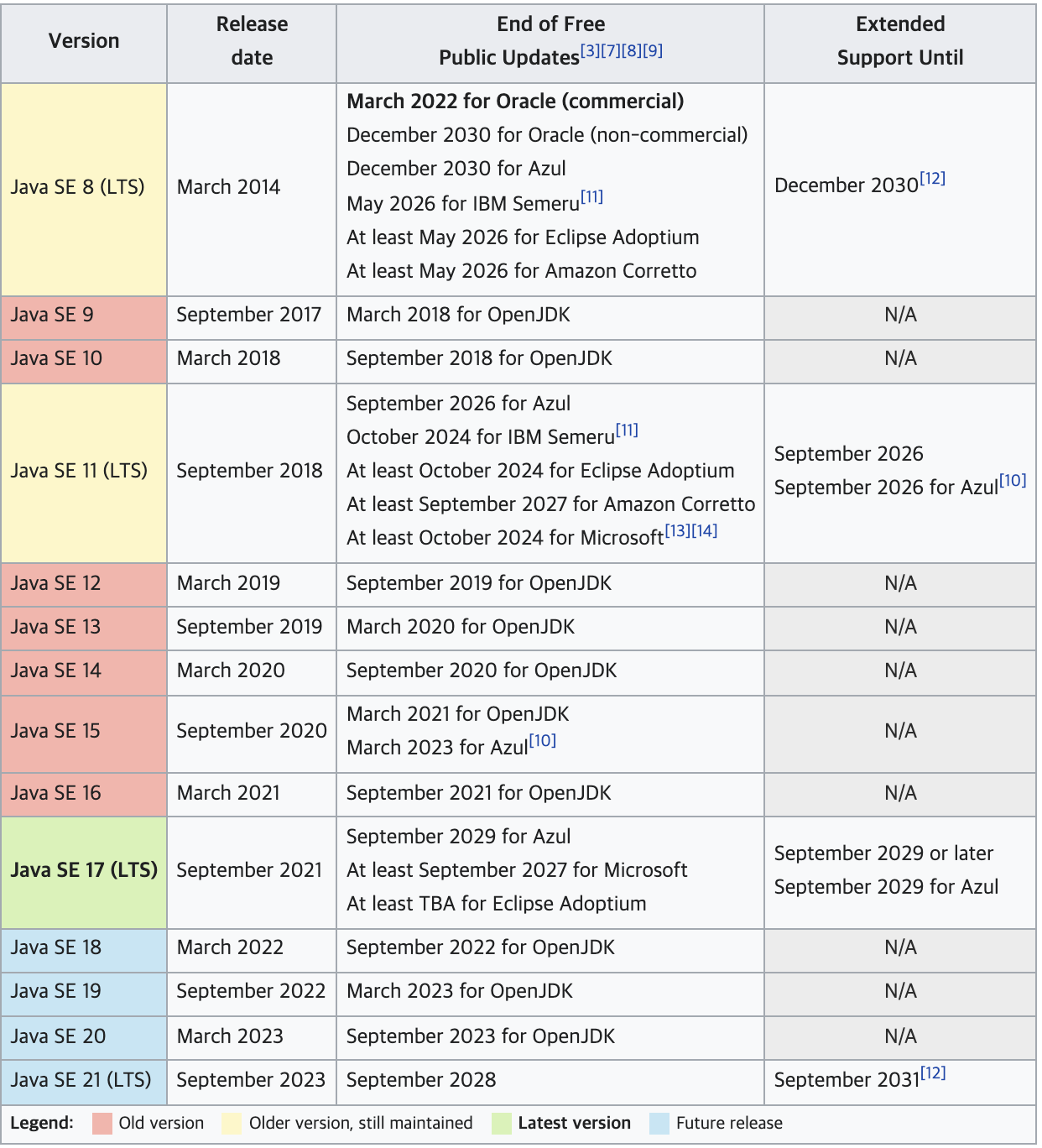
Java follows the release plan below (source: Wikipedia). Java 17 is the first new LTS since Java 11 in 2018. The next LTS is Java 21, scheduled for 2023. For complete Java version history, see Oracle Java roadmap or Wikipedia Java version history.
JDK 17 Release Notes
This summary focuses on code-related changes based on JEP (JDK Enhancement Proposal). The full release list is in OpenJDK JDK17.
JEP 356: Enhanced Pseudo-Random Number Generators
A new RandomGenerator API was added by extending and refactoring legacy random APIs (java.util.Random).
You can inspect available Java 17 algorithms with the following code.
RandomGeneratorFactory.all()
	.map(factory -> String.format("%s: %s", factory.group(), factory.name()))
	.sorted()
	.forEach(System.out::println);
LXM: L128X1024MixRandom
LXM: L128X128MixRandom
LXM: L128X256MixRandom
LXM: L32X64MixRandom
LXM: L64X1024MixRandom
LXM: L64X128MixRandom
LXM: L64X128StarStarRandom
LXM: L64X256MixRandom
Legacy: Random
Legacy: SecureRandom
Legacy: SplittableRandom
Xoroshiro: Xoroshiro128PlusPlus
Xoshiro: Xoshiro256PlusPlus
JEP 382: New macOS Rendering Pipeline
This follows Apple’s move from OpenGL to Metal rendering APIs. The purpose is readiness for future macOS versions where OpenGL APIs may be removed. It is not directly related to application code, but rendering in IDEs such as IntelliJ on macOS can improve.
JEP 398: Deprecate the Applet API for Removal
Applet API was already marked @Deprecated since Java 9.
In this version, forRemoval is also set.
It may disappear in the next release.
@Deprecated(since = "9", forRemoval = true)
@SuppressWarnings("removal")
public class Applet extends Panel {
	// ...
}
JEP 403: Strongly Encapsulate JDK Internals
JDK strongly encapsulates all internal elements except critical internal APIs. Reflection code like below no longer works.
var ks = java.security.KeyStore.getInstance("jceks");
var f = ks.getClass().getDeclaredField("keyStoreSpi");
f.setAccessible(true);
JEP 406: Pattern Matching for switch (Preview)
This has existed since Java 14 and is still a preview feature. You need runtime options to execute it. (In IntelliJ, change Language Level.)
As in the example below, casting with instanceof becomes simpler.
// AS-IS: old instanceof usage, explicit casting required.
if (o instanceof String) {
    String s = (String) str;
    // ... code that uses variable s
}

// TO-BE: no explicit cast, bind to variable 's'.
if (o instanceof String s) {
    // ... code that uses variable s
}
Handling null also gets simpler.
// before
static void someMethod(String s) {
    if (s == null) {
        System.out.println("null!");
        return;
    }

    switch (s) {
        case "kim", "taeng" -> System.out.println("Hello~");
        default -> System.out.println("Wow!");
    }
}

// after
static void someMethod(String s) {
    switch (s) {
        case null -> System.out.println("null!");
        case "kim", "taeng" -> System.out.println("Hello~");
        default -> System.out.println("Wow!");
    }
}
You can also apply pattern matching directly in switch.
In the example below, parameter o matches Long l, so that branch executes.
Object o = 123L;
String formatted = switch (o) {
    case Integer i -> String.format("int %d", i);
    case Long l -> String.format("long %d", l);
    case Double d -> String.format("double %f", d);
    case String s -> String.format("String %s", s);
    default -> o.toString();
};
JEP 407: Remove RMI Activation
Some RMI features (java.rmi.activation package) were removed.
JEP 409: Sealed Classes
Java reuses code through inheritance, but unrestricted inheritance can reduce readability. So Java introduces a way to constrain inheritance. As you can see in JEP specs, this is a new paradigm and relatively complex. It was introduced as preview across multiple releases.
The core idea is: “Limit which classes/interfaces can extend or implement this type.”
Previously, Java already had one way to block inheritance: final.
class Person {
}

// `Developer` cannot be extended.
final class Developer extends Person {
}

// `Designer` cannot be extended.
final class Designer extends Person {
}
Sealed classes are different. They allow extension for specific subclasses and seal others.
// `Person` can be extended only by permitted subclasses.
sealed class Person
    permits Developer, Designer {
}

// `Developer` is unsealed.
non-sealed class Developer extends Person {

}

// unsealed `Developer` can be extended again.
sealed class Student extends Developer
    permits HighSchoolStudent, MiddleSchoolStudent {
    // this class can be extended only by `HighSchoolStudent` and `MiddleSchoolStudent`.
}

// permitted subclasses must choose one: final, sealed, or non-sealed.
final class HighSchoolStudent extends Student {

}

non-sealed class MiddleSchoolStudent extends Student {

}
Rules for sealed classes include:
- A sealed class and its permitted subclasses must belong to the same module or package.
- Every permitted subclass must extend the sealed class. Otherwise compilation fails.
- Every permitted subclass must declare whether to continue the sealing started by its superclass.
- Use
finalto disallow further extension. - Use
non-sealedto allow extension by other classes. - Or declare itself as
sealed.
- Use
JEP 410: Remove the Experimental AOT and JIT Compiler
AOT (Ahead-Of-Time) and JIT (Just-In-Time) experimental compiler modules were removed.
Targets are jdk.aot, jdk.internal.vm.compiler, and jdk.internal.vm.compiler.management.
JEP 411: Deprecate the Security Manager for Removal
java.lang.SecurityManager and some related classes were marked with @Deprecated(forRemoval=true).
Others
From the previous post (What features were added in Java 14?), some preview items became official.
JEP 359: Records
record was finalized in Java 16 and became a permanent feature.
record RecordPoint(int x, int y) {
    // cannot be inherited (final class)

    // each field is private final, immutable
    // x = 5;

    // what about serialize? add `@JsonProperty` on fields.

    // can contain static fields and methods
    static int MAX_LENGTH = 25;

    public static int getMaxLength() {
        return MAX_LENGTH;
    }
}

// usage? instantiate with `new`, same as class.
RecordPoint recordPoint = new RecordPoint(2, 3);

// getters are generated automatically.
recordPoint.x();
JEP 378: Text Blocks
This became official in Java 15.
No more long string concatenation with + and \n.
private void runJEP368() {
    String html = """
            {
                "list": [
                    {
                        "title": "hello, taeng",
                        "author": "taeng"
                    },
                    {
                        "title": "hello, news",
                        "author": "taeng"
                    }
                ]
            }
            """.indent(2);
    // indent was added in Java 12; it indents each line head by n spaces.
    System.out.println(html);
}
You can also map variables like below.
String textBlock = """
        {
            "title": %s,
            "author": %s,
            "id": %d
        }
        """.formatted("hi", "taeng", 2);

System.out.println(textBlock);
Output:
{
  "title": hi,
  "author": taeng,
  "id": 2
}
Closing
This LTS release raises strong expectations. Personally, I like that Java keeps adding ways to write more concise code, such as pattern matching and records. Text blocks in particular seem to resolve readability and maintainability pain points, as discussed in “Managing SQL When Using Spring JDBC”.
As noted last year, new technologies now appear and evolve faster than the pace of individual learning.