N+1 Problem?
In JPA, when loading entities with relationships, additional queries can run for each loaded row. Let’s check this with an example.
Entity setup
In this example, related entities use FetchType.EAGER so they load eagerly.
@Entity
public class User {
	@Id
	private Integer id;
	private String name;
	private String level;

	@OneToMany(fetch = FetchType.EAGER)
	@JoinColumn(name = "user_id", referencedColumnName = "id")
	private List<Article> articleList;

	@ManyToOne
	@JoinColumn(name = "team_id", referencedColumnName = "id")
	private Team team;
}

@Entity
public class Article {
	@Id
	private Integer id;
	@Column(name = "user_id")
	private Integer userId;
	private String title;
}

@Entity
public class Team {
	@Id
	private Integer id;
}
Sample table data:
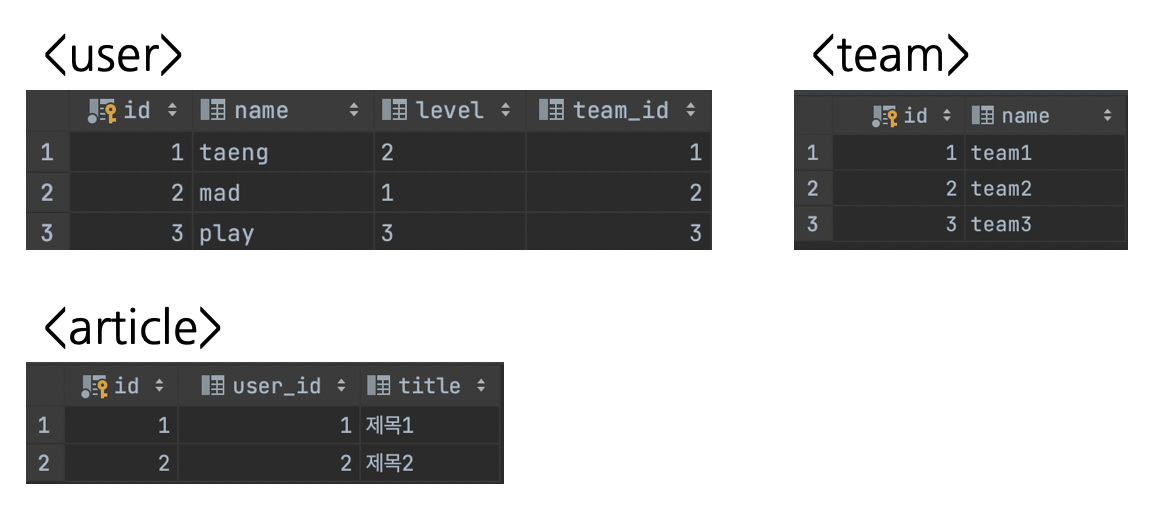
Querying data
With the entity structure and data above, what happens when querying all users?
First, enable SQL logging.
Then run findAll.
spring.jpa.properties.hibernate.show_sql=true # print SQL
spring.jpa.properties.hibernate.format_sql=true # pretty SQL formatting
spring.jpa.properties.hibernate.generate_statistics=true # print query statistics
Query result:
Hibernate:
    select
        user0_.`id` as id1_2_,
        user0_.`level` as level2_2_,
        user0_.`name` as name3_2_,
        user0_.`team_id` as team_id4_2_
    from
        `user` user0_
Hibernate:
    select
        team0_.`id` as id1_1_0_
    from
        `team` team0_
    where
        team0_.`id`=?
Hibernate:
    select
        team0_.`id` as id1_1_0_
    from
        `team` team0_
    where
        team0_.`id`=?
Hibernate:
    select
        team0_.`id` as id1_1_0_
    from
        `team` team0_
    where
        team0_.`id`=?
Hibernate:
    select
        articlelis0_.`user_id` as user_id3_0_0_,
        articlelis0_.`id` as id1_0_0_,
        articlelis0_.`id` as id1_0_1_,
        articlelis0_.`title` as title2_0_1_,
        articlelis0_.`user_id` as user_id3_0_1_
    from
        `article` articlelis0_
    where
        articlelis0_.`user_id`=?
Hibernate:
    select
        articlelis0_.`user_id` as user_id3_0_0_,
        articlelis0_.`id` as id1_0_0_,
        articlelis0_.`id` as id1_0_1_,
        articlelis0_.`title` as title2_0_1_,
        articlelis0_.`user_id` as user_id3_0_1_
    from
        `article` articlelis0_
    where
        articlelis0_.`user_id`=?
Hibernate:
    select
        articlelis0_.`user_id` as user_id3_0_0_,
        articlelis0_.`id` as id1_0_0_,
        articlelis0_.`id` as id1_0_1_,
        articlelis0_.`title` as title2_0_1_,
        articlelis0_.`user_id` as user_id3_0_1_
    from
        `article` articlelis0_
    where
        articlelis0_.`user_id`=?

769887 nanoseconds spent acquiring 1 JDBC connections;
0 nanoseconds spent releasing 0 JDBC connections;
23142915 nanoseconds spent preparing 7 JDBC statements;
10451025 nanoseconds spent executing 7 JDBC statements;
0 nanoseconds spent executing 0 JDBC batches;
0 nanoseconds spent performing 0 L2C puts;
0 nanoseconds spent performing 0 L2C hits;
0 nanoseconds spent performing 0 L2C misses;
0 nanoseconds spent executing 0 flushes (flushing a total of 0 entities and 0 collections);
10855 nanoseconds spent executing 1 partial-flushes (flushing a total of 0 entities and 0 collections)
As statistics show, querying 3 rows from User executes 7 queries total.
Additional queries run for associated entities.
Does Lazy loading solve it?
The issue is not caused by FetchType.EAGER in @OneToMany alone.
Even with Lazy, additional queries run when association references are accessed.
So loading strategy itself does not eliminate the issue.
Also, accessing lazy-loaded entities can throw lazyinitializationexception.
This happens when data is referenced outside a JPA-managed session.
You can address it with @Transactional as below.
@Transactional
public List<User> getAllUserList() {
    List<User> userList = userRepository.findAll();

    // without @Transactional, `lazyinitializationexception` occurs
    List<ArticleList> articleList = userList.get(0).getArticleList();
}
Then how to solve it?
Approaches include BatchSize and EntityGraph.
This post focuses on Querydsl fetch join.
For Querydsl setup, see below.
- Reference: Querydsl: Introduction and Usage
Core point is fetchJoin.
It eagerly loads joined targets.
Because duplicates can occur during this process, distinct is added.
public List<User> findAllByQuerydsl() {
	QUser user = QUser.user;
	QArticle article = QArticle.article;
	QTeam team = QTeam.team;

	return queryFactory.select(user)
	.from(user)
	.leftJoin(user.articleList, article)
	.fetchJoin()
	.leftJoin(user.team, team)
	.fetchJoin()
	.distinct()
	.fetch();
}
Hibernate:
    select
        distinct user0_.`id` as id1_2_0_,
        articlelis1_.`id` as id1_0_1_,
        team2_.`id` as id1_1_2_,
        user0_.`level` as level2_2_0_,
        user0_.`name` as name3_2_0_,
        user0_.`team_id` as team_id4_2_0_,
        articlelis1_.`title` as title2_0_1_,
        articlelis1_.`user_id` as user_id3_0_1_,
        articlelis1_.`user_id` as user_id3_0_0__,
        articlelis1_.`id` as id1_0_0__
    from
        `user` user0_
    left outer join
        `article` articlelis1_
            on user0_.`id`=articlelis1_.`user_id`
    left outer join
        `team` team2_
            on user0_.`team_id`=team2_.`id`

20364 nanoseconds spent acquiring 1 JDBC connections;
0 nanoseconds spent releasing 0 JDBC connections;
184222 nanoseconds spent preparing 1 JDBC statements;
838233 nanoseconds spent executing 1 JDBC statements;
0 nanoseconds spent executing 0 JDBC batches;
0 nanoseconds spent performing 0 L2C puts;
0 nanoseconds spent performing 0 L2C hits;
0 nanoseconds spent performing 0 L2C misses;
0 nanoseconds spent executing 0 flushes (flushing a total of 0 entities and 0 collections);
0 nanoseconds spent executing 0 partial-flushes (flushing a total of 0 entities and 0 collections)
The result shows associated data is loaded through join in one query instead of multiple queries. Using Querydsl fetch join avoids the JPA N+1 problem.