Generics Are Invariant
As discussed in
[Effective Java 3rd Edition] Item 28. Prefer lists to arrays,
parameterized types are invariant. For types Type1 and Type2, List<Type1> is neither a subtype nor a supertype of List<Type2>.
To expand: List<Object> can hold any object, but List<String> can hold only strings.
List<String> cannot serve as a drop-in replacement for List<Object>, so it is not a subtype.
If you are new to generics, start here:
Producers and Wildcards
Assume the Stack public API includes a method that pushes all elements from a parameter.
// add all elements from src to the stack
public void pushAll(Iterable<E> src) {
    for (E e : src) {
        push(e);
    }
}
This compiles, but if you pass an Iterable<Integer> into a Stack<Number>, the compiler fails.
Integer is a subtype of Number, yet the error says Iterable<Integer> cannot be converted to Iterable<Number>.
import java.util.Arrays;

/**
 * Source code from Item 29
 */
class Stack<E> {
    private Object[] elements;
    private int size = 0;
    private static final int DEFAULT_INITIAL_CAPACITY = 16;

    public Stack() {
        elements = new Object[DEFAULT_INITIAL_CAPACITY];
    }

    public void push(E e) {
        ensureCapacity();
        elements[size++] = e;
    }

    private void ensureCapacity() {
        if (elements.length == size)
            elements = Arrays.copyOf(elements, 2 * size + 1);
    }

    // ... omitted

    // add all elements from src to the stack
    public void pushAll(Iterable<E> src) {
        for (E e : src) {
            push(e);
        }
    }
}

class Item28Test {
    public static void main(String[] args) {
        Stack<Number> numberStack = new Stack<>();
        Iterable<Integer> integers = Arrays.asList(
                Integer.valueOf(1), Integer.valueOf(2));

        // incompatible types...
        numberStack.pushAll(integers);
    }
}
Because parameterized types are invariant, there is no subtype relationship here.
To fix this, use a bounded wildcard.
Since Integer extends Number, declare the parameter like this:
// class Integer extends Number ...
public void pushAll(Iterable<? extends E> src) {
    for (E e : src) {
        push(e);
    }
}
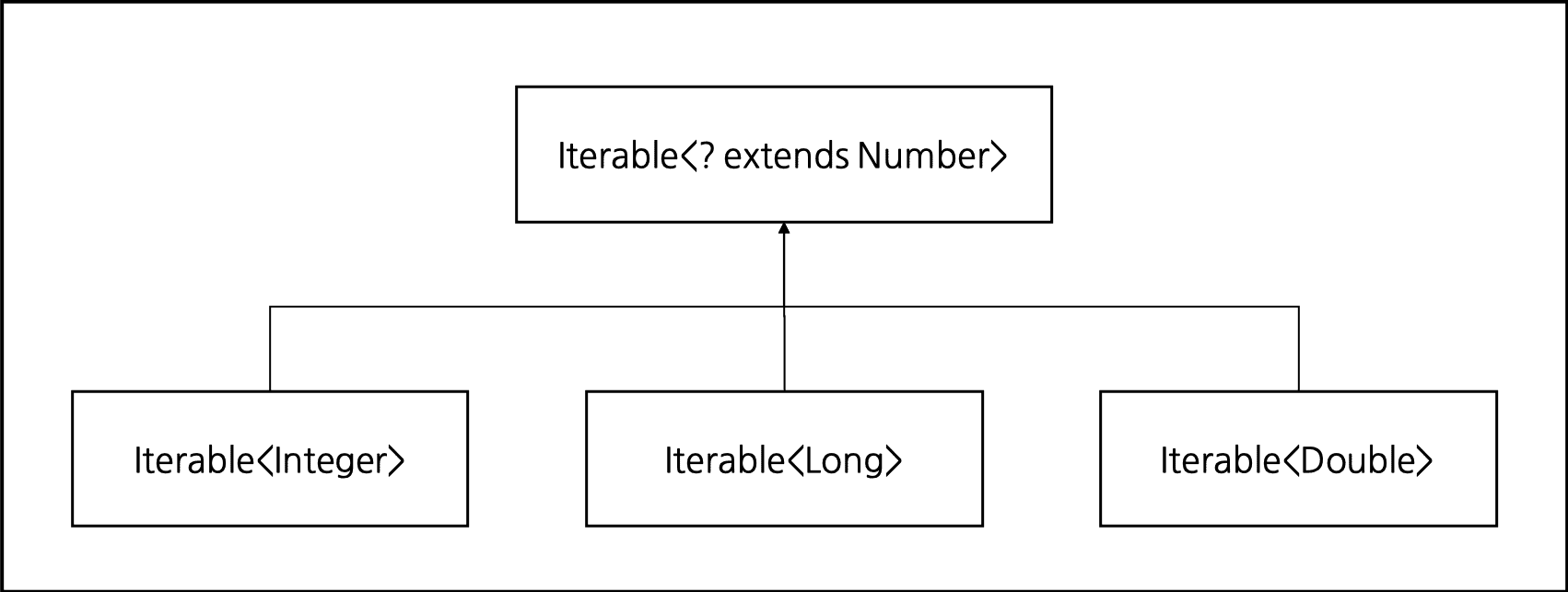
This means the parameter is not an Iterable<E>, but an Iterable of a subtype of E.
Now the method accepts Integer, Long, Double, and any other subtype of Number.
The custom Stack can add elements only via push(E), so type safety holds.
However, the elements array is an Object[], not an E[], because generics are erased at runtime.
Consumers and Wildcards
Now write a popAll method that moves all stack elements into a collection parameter.
import java.util.Arrays;
import java.util.Collection;
import java.util.EmptyStackException;

// Effective Java Item 29 source
class Stack<E> {
    private Object[] elements;
    private int size = 0;
    private static final int DEFAULT_INITIAL_CAPACITY = 16;

    public Stack() {
        elements = new Object[DEFAULT_INITIAL_CAPACITY];
    }

    public void push(E e) {
        ensureCapacity();
        elements[size++] = e;
    }

    private void ensureCapacity() {
        if (elements.length == size)
            elements = Arrays.copyOf(elements, 2 * size + 1);
    }

    public boolean isEmpty() {
        return size == 0;
    }

    public E pop() {
        if (size == 0)
            throw new EmptyStackException();

        // safe cast because push accepts only E
        @SuppressWarnings("unchecked") E result =
                (E) elements[--size];

        elements[size] = null; // eliminate obsolete reference
        return result;
    }

    // add all elements from src to the stack
    public void pushAll(Iterable<? extends E> src) {
        for (E e : src) {
            push(e);
        }
    }

    // move all elements into the destination collection
    public void popAll(Collection<E> dst) {
        while(!isEmpty()) {
            dst.add(pop());
        }
    }
}

class Item28Test {
    public static void main(String[] args) {
        Stack<Number> numberStack = new Stack<>();
        Collection<Object> objects = Arrays.asList(new Object());

        // incompatible types...
        numberStack.popAll(objects);
    }
}
The same error appears. The element types differ, and invariance blocks the assignment.
To fix it, declare the parameter as a supertype of E.
// the collection must accept E or its supertypes
public void popAll(Collection<? super E> dst) {
    while(!isEmpty()) {
        dst.add(pop());
    }
}
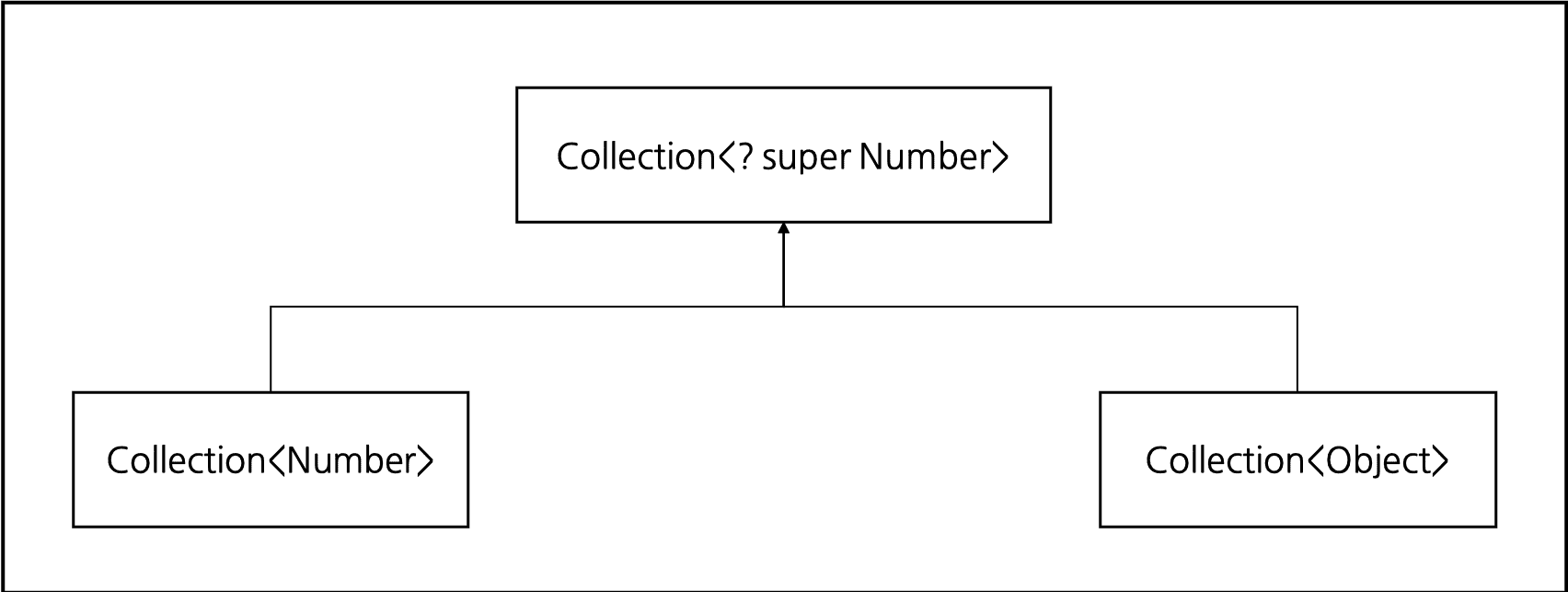
Because any type is a supertype of itself, Collection<? super Number> accepts Collection<Number> and Collection<Object>.
PECS
Producer-Extends-Consumer-Super = PECS As shown in the examples, use the right wildcard to improve flexibility. If you forget which one to use, remember PECS.
When a parameter produces, use <? extends T>.
When it consumes, use <? super T>.
In pushAll, the parameter src produces elements for the stack, so it is a producer.
That is why the parameter uses extends.
// class Integer extends Number ...
public void pushAll(Iterable<? extends E> src) {
    for (E e : src) {
        push(e);
    }
}
In popAll, the parameter dst consumes elements from the stack, so it is a consumer.
That is why the parameter uses super.
// the collection must accept E or its supertypes
public void popAll(Collection<? super E> dst) {
    while(!isEmpty()) {
        dst.add(pop());
    }
}
Advanced
Do not use wildcards in return types. That forces callers to deal with wildcards as well.
For example, a union method that merges two sets uses extends because both parameters are producers.
The return type is a concrete Set<E>, so callers do not deal with wildcards.
public class Union {
    public static <E> Set<E> union(Set<? extends E> s1, Set<? extends E> s2) {
        Set<E> result = new HashSet<>(s1);
        result.addAll(s2);
        return result;
    }

    public static void main(String[] args) {
        // Set.of is supported in Java 9+
        Set<Double> doubleSet = Set.of(1.0, 2.1);
        Set<Integer> integerSet = Set.of(1, 2);
        Set<Number> unionSet = union(doubleSet, integerSet);
    }
}
This code compiles on Java 9. If you use Java 8 or earlier, the compiler cannot infer the type and you must provide the type argument explicitly.
public class Union {
    public static <E> Set<E> union(Set<? extends E> s1, Set<? extends E> s2) {
        Set<E> result = new HashSet<>(s1);
        result.addAll(s2);
        return result;
    }

    public static void main(String[] args) {
        // compiled with Java 7
        Set<Double> doubleSet = new HashSet<>(Arrays.asList(1.0, 2.1));
        Set<Integer> integerSet = new HashSet<>(Arrays.asList(1, 2));
        Set<Number> unionSet = Union.<Number>union(doubleSet, integerSet);
    }
}
Now look at a method that uses a recursive type bound:
class RecursiveTypeBound {
    public static <E extends Comparable<E>> E max(Collection<E> collection) {
        if (collection.isEmpty()) {
            // Exception Handling
        }

        E result = null;
        for (E e : collection) {
            if (result == null || e.compareTo(result) > 0) {
                result = Objects.requireNonNull(e);
            }
        }
        return result;
    }
}

class Item28Test {
    public static void main(String[] args) {
        List<Integer> integerList = Arrays.asList(1, 3, 2);
        System.out.println(RecursiveTypeBound.max(integerList));
    }
}
Apply PECS here as well. The parameter produces E, so it becomes Collection<? extends E>.
Comparable consumes E, so it becomes Comparable<? super E>.
That gives:
// before
public static <E extends Comparable<E>> E max(Collection<E> collection)

// after (PECS applied twice)
public static <E extends Comparable<? super E>> E max(Collection<? extends E> collection)
This form supports types that extend a class implementing Comparable, not only those that implement it directly.
For example, look at ScheduledFuture (Java 5+). It extends Delayed, which extends Comparable<Delayed>.
But ScheduledFuture does not extend Comparable<ScheduledFuture>.
// ScheduledFuture interface
public interface ScheduledFuture<V> extends Delayed, Future<V> {
    // ...
}

// Delayed interface
public interface Delayed extends Comparable<Delayed> {
    // ...
}

// Comparable interface
public interface Comparable<T> {
    // ...
}
Without PECS, the original max rejects this case:
class RecursiveTypeBound {
    public static <E extends Comparable<E>> E max(Collection<E> collection) {
        // ...
    }
}

class Item28Test {
    public static void main(String[] args) {
        List<ScheduledFuture<?>> scheduledFutureList = ...

        // incompatible types...
        RecursiveTypeBound.max(scheduledFutureList);
    }
}
Finally, here is a comparison between type parameters and wildcards:
class swapTest {
    // Option 1) unbounded type parameter
    public static <E> void typeArgSwap(List<E> list, int i, int j) {
        list.set(i, list.set(j, list.get(i)));
    }

    // Option 2) unbounded wildcard
    public static void wildcardSwap(List<?> list, int i, int j) {
        wildcardSwapHelper(list, i, j);
    }

    // Option 2-1) a wildcard list accepts only null
    // same signature (name and parameters) as option 1
    private static <E> void wildcardSwapHelper(List<E> list, int i, int j) {
        list.set(i, list.set(j, list.get(i)));
    }
}
For public APIs, option 2 is convenient because callers do not specify type parameters.
However, List<?> accepts only null, so you need a helper method to capture the type.
The helper method captures the list’s element type, so it can write values safely. It adds an extra method, but it gives clients a type-agnostic API.