What is Inheritance
- It’s a characteristic of object-oriented languages and a technology that enables software reuse.
- A real-life example would be similar to genetic inheritance where children inherit parent genes.
- It’s similar to the concept of inheritance in
C++language.- The difference is that multiple inheritance is not possible in Java.
- In Java, parent-child inheritance relationships are declared between two classes.
- At this time, the parent class is called a super class, and the child class is called a sub class.
- Sub classes include not only their own members but also super class members.
Base class? Parent class?
The names for two classes in an inheritance relationship differ slightly by programming language. In C++, the class that provides inheritance is called a base class, and conversely, the class that receives inheritance is called a derived class. Also, in C#, they’re called parent class and child class respectively.
Advantages of Inheritance
Examining the advantages inheritance provides through the example code below:
class Student {
    void eat() {} // eating
    void sleep() {} // sleeping
    void study() {} // studying
}

class StudentDeveloper {
    void eat() {} // eating
    void sleep() {} // sleeping
    void study() {} // studying
    void develop() {} // developing
}

class Professor {
    void eat() {} // eating
    void sleep() {} // sleeping
    void research() {} // researching
}
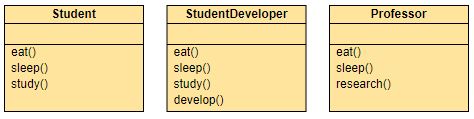
- There are Student, StudentDeveloper, and Professor.
- They all have common behaviors (code) of eating (eat) and sleeping (sleep).
- Also, Student and StudentDeveloper have common behavior (code) of studying (study).
- If we assume that eating and sleeping don’t differ and serve the same role, the inconvenience arises of having to modify all three classes above to modify one behavior.
- Using inheritance, you can modify it concisely as shown below:
class Person {
    void eat() {} // eating
    void sleep() {} // sleeping
}

class Student extends Person {
    void study() {} // studying
}

class StudentDeveloper extends Student {
    void develop() {} // developing
}
- Common characteristics were grouped and defined as a Person class.
- And classes that need common characteristics inherit and use it.
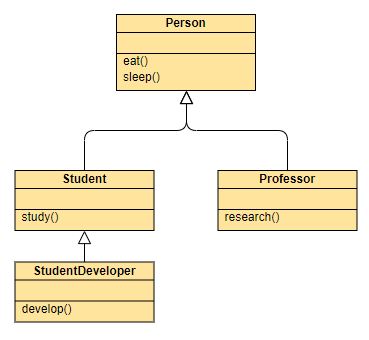
- As such, inheritance has the advantage of not having to duplicate member declarations between classes.
- It also allows hierarchical classification of classes, enabling efficient management.
- Therefore, it can improve software productivity through class reuse and extension.
How to Use Inheritance
Declaration Method
- In Java, inheritance is declared using the
extendskeyword. - Write it as
class sub class extends super class.
Usage
class Point {
    private int xPos, yPos;

    void setPoint(int xPos, int yPos) {
        this.xPos = x;
        this.yPos = y;
    }

    void showPoint() {
        System.out.println("(" + xPos + "," + yPos + ")");
    }
}

class ColorPoint extends Point {
    private String color;

    void setColor(String color) {
        this.color = color;
    }

    void showColorPoint() {
        showPoint(); // Call Point class's showPoint method
        System.out.println("Color : " + color);
    }
}

public class ExampleTest {
    public static void main(String[] args) {
        Point p = new Point();
        p.setPoint(3, 4);
        p.showPoint();

        ColorPoint cp = new ColorPoint();
        cp.setPoint(2, 3);
        cp.setColor("Yellow");
        cp.showColorPoint();
    }
}
- Sub classes extend super class members as their own members through inheritance.
- Therefore, they can access all members except private members of the super class.
- That is, ColorPoint not only has its own member variable string color but also Point class’s integer xPos and yPos by inheriting the Point class.
- Also, the sub class ColorPoint’s member method showColorPoint can call the super class’s showPoint.
- However, since xPos and yPos are Point’s private members, Color class members cannot access them.
- Therefore, they access indirectly through setPoint and showPoint methods.
Types of Inheritance
- Java doesn’t specify public inheritance, protected inheritance, etc. like C++.
- As mentioned above, it’s only declared as
sub class extends super class, and depending on the access specifiers of super class members, they’re inherited differently to the sub class.
class Point {
    private int privateVal;
    protected int protectedVal;
    public int publicVal;
    int defaultVal;
}

// In the same package.
class ColorPoint extends Point {
    void someMethod() {
        privateVal = 1; // Error!
        protectedVal = 2;
        publicVal = 3;
        defaultVal = 4;
    }
}
| Class type accessing super class members | private | default | protected | public |
|---|---|---|---|---|
| Same package class | X | O | O | O |
| Different package class | X | X | X | O |
| Same package sub class | X | O | O | O |
| Different package sub class | X | X | O | O |
Inheritance and Constructors
Constructors of Super Class and Sub Class
- Both super class and sub class have constructors.
- When a sub class object is created, both the sub class constructor and super class constructor execute.
- Since the purpose of constructors is object initialization, sub class constructors perform initialization of sub class members or necessary initialization.
- Super class constructors each perform initialization of super class members or necessary initialization.
- Among super class constructors and sub class constructors, the super class constructor executes first.
class Point {
    Point() {
        // Executes first.
        System.out.println("Point constructor executed");
    }
}

class ColorPoint extends Point {
    ColorPoint() {
        // Executes afterward.
        System.out.println("ColorPoint constructor executed");
    }
}

class ExampleTest {
    public static void main(String[] args) {
        ColorPoint cp = new ColorPoint();
    }
}
- When the
newstatement executes, the compiler calls the ColorPoint constructor. - However, ColorPoint first calls the super class constructor before executing its own code.
- The sub class constructor is called first, but ultimately the super class constructor executes first.
- For any sub class, regarding constructors, the compiler compiles to call the super class constructor and then execute its own code.
- This is because the super class must be initialized first, and then the sub class inheriting it must be initialized.
Sub Class Calling Super Class Constructor
- There can be multiple super class constructors. Of course, the same goes for sub classes.
- If the super class constructor is not explicitly specified, the compiler compiles to implicitly call the super class’s default constructor.
class Point {
    Point() {
        // Executes first.
        System.out.println("Point default constructor");
    }

    Point(int x) {
        // Does not execute.
        System.out.println("Point parameter constructor");
    }
}

class ColorPoint extends Point {
    ColorPoint() {
        // Executes second.
        System.out.println("ColorPoint default constructor");
    }
}

class ExampleTest {
    public static void main(String[] args) {
        ColorPoint cp = new ColorPoint();
    }
}
- If the super class’s default constructor is not declared, an error occurs.
- Even when calling a constructor with parameters from the sub class constructor, the compiler implicitly calls the super class’s default constructor.
- To explicitly select the super class constructor, write the code as shown below:
class Point {
    Point() {
        System.out.println("Point default constructor");
    }

    Point(int x) {
        System.out.println("Point parameter constructor");
    }
}

class ColorPoint extends Point {
    ColorPoint() {
        System.out.println("ColorPoint default constructor");
    }

    ColorPoint(int x) {
        super(x); // Must be at the method start position.
        System.out.println("ColorPoint parameter constructor");
    }
}
- Code that explicitly calls the super class constructor using the
superkeyword must be on the first line of the sub class constructor.- Otherwise, an error occurs. Constructor call must be the first statement in a constructor